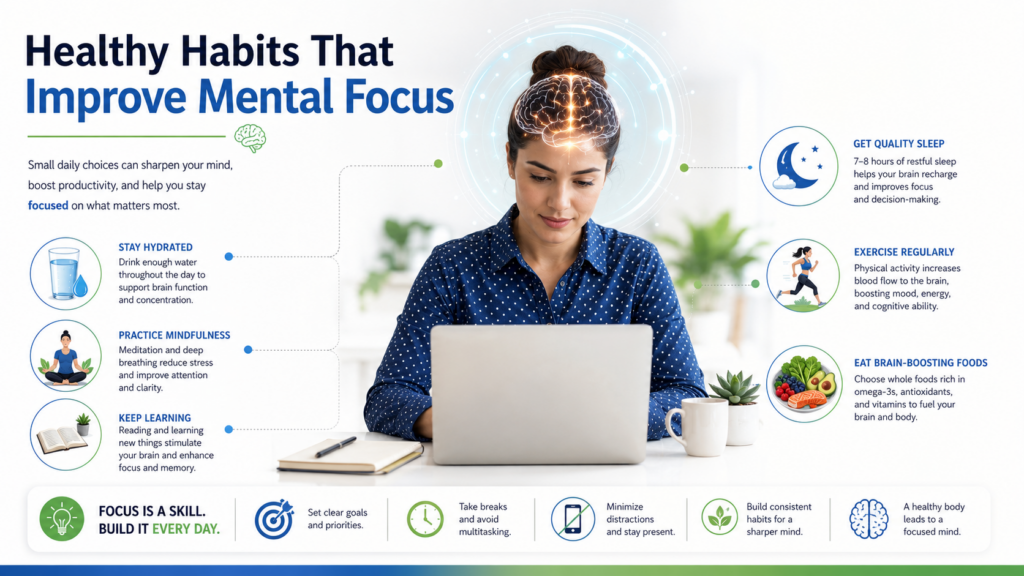
Mental focus is the ability to direct your attention toward one task, idea, or goal without being easily distracted. It affects productivity, learning, decision-making, memory, creativity, and emotional control. In today’s world, where people constantly switch between phones, notifications, work pressure, social media, and daily responsibilities, staying focused has become more difficult than ever.
The good news is that mental focus is not only a “talent.” It can be improved with the right daily habits. Your brain needs proper sleep, nutrition, hydration, movement, stress control, and a healthy environment to work at its best. This article explains the most important healthy habits that support mental focus naturally, based on science and practical lifestyle strategies.
Note: This content is for educational purposes only and should not replace medical advice. If you experience severe brain fog, memory issues, anxiety, depression, or sleep problems, consult a qualified healthcare professional.
What Is Mental Focus?
Mental focus is closely linked to attention, working memory, and executive function. Executive functions help you plan, organize, control impulses, solve problems, and stay on task. You can learn more about this concept from Wikipedia’s page on executive functions.
When your focus is strong, you can read, work, study, or solve problems without constantly losing track. When your focus is weak, you may feel distracted, mentally tired, forgetful, or unable to complete tasks.
Common signs of poor mental focus include:
| Sign | What It May Feel Like |
| Brain fog | Thoughts feel slow or unclear |
| Easy distraction | Small noises, phone alerts, or thoughts interrupt work |
| Poor memory | Forgetting tasks, names, or instructions |
| Low motivation | Starting work feels difficult |
| Mental fatigue | Feeling tired even without physical work |
| Procrastination | Delaying important tasks repeatedly |
Mental focus depends on both brain health and lifestyle quality. That means improving your daily habits can directly support clearer thinking and better concentration.
1. Prioritize Quality Sleep
Sleep is one of the most powerful habits for improving mental focus. During sleep, the brain processes information, stores memories, clears metabolic waste, and restores energy. Poor sleep can reduce attention, reaction time, decision-making, emotional control, and learning ability.
According to the CDC’s sleep and sleep disorders information, adults generally need enough quality sleep each night to support overall health and daily function. Sleep affects how well your brain performs the next day.
How Sleep Improves Focus
When you sleep well, your brain becomes better at:
| Brain Function | How Sleep Helps |
| Attention | Helps you stay alert and focused |
| Memory | Supports learning and recall |
| Emotional control | Reduces irritability and stress response |
| Problem-solving | Improves logical thinking |
| Energy regulation | Prevents daytime fatigue |
Healthy Sleep Habits
To improve focus through sleep, try these habits:
- Sleep and wake up at the same time daily.
- Avoid screens at least 30–60 minutes before bed.
- Keep your room cool, dark, and quiet.
- Avoid heavy meals late at night.
- Limit caffeine in the evening.
- Create a relaxing routine such as reading, stretching, or deep breathing.
Even one night of poor sleep can affect focus, but chronic poor sleep can cause long-term problems with mood, memory, and productivity.
2. Exercise Regularly to Boost Brain Performance
Physical activity is not only good for the body; it is also excellent for the brain. Regular exercise improves blood flow, oxygen delivery, mood, and brain chemicals involved in learning and attention. It may also support neuroplasticity, which is the brain’s ability to adapt and form new connections.
The World Health Organization’s physical activity guidance highlights the importance of regular movement for overall health. Exercise is also associated with better mental well-being and cognitive function.
Best Exercises for Mental Focus
| Type of Exercise | Benefit for Focus |
| Walking | Improves blood flow and reduces mental fatigue |
| Strength training | Supports energy, confidence, and brain health |
| Yoga | Combines movement, breathing, and stress control |
| Cycling | Boosts cardiovascular health and alertness |
| Stretching | Relieves body tension that distracts the mind |
You do not need intense workouts every day. Even a 20–30 minute brisk walk can improve alertness and mental clarity. If you work or study for long hours, short movement breaks can refresh your brain.
Practical Tip
Use the “movement reset” method: after 60–90 minutes of focused work, stand up, stretch, walk for 5 minutes, or do light breathing exercises. This helps prevent mental fatigue and restores attention.
3. Eat Brain-Supportive Foods
Your brain uses a large amount of energy, so food quality strongly affects mental performance. Diets rich in whole foods, healthy fats, protein, vitamins, minerals, and antioxidants may support attention, memory, and mood.
A brain-supportive diet usually includes fruits, vegetables, whole grains, nuts, seeds, legumes, lean proteins, and healthy fats. The Harvard T.H. Chan School of Public Health Nutrition Source provides useful guidance on healthy eating patterns.
Foods That Support Mental Focus
| Food Group | Examples | How They May Help |
| Omega-3 rich foods | Fatty fish, walnuts, chia seeds, flaxseeds | Support brain cell function |
| Protein foods | Eggs, lentils, beans, tofu, fish, chicken | Help neurotransmitter production |
| Whole grains | Oats, brown rice, quinoa | Provide steady energy |
| Leafy greens | Spinach, kale, mustard greens | Provide folate, magnesium, and antioxidants |
| Berries | Blueberries, strawberries | Rich in antioxidants |
| Nuts and seeds | Almonds, pumpkin seeds, sunflower seeds | Provide minerals and healthy fats |
| Fermented foods | Yogurt, kefir, kimchi | Support gut-brain connection |
Foods That May Reduce Focus
Some foods may make focus worse when eaten too often:
| Food or Habit | Possible Effect |
| Sugary drinks | Energy spikes and crashes |
| Highly processed snacks | Low nutrient value |
| Excess fried foods | May increase sluggishness |
| Too much caffeine | Anxiety, sleep disruption |
| Skipping meals | Low energy and poor concentration |
A balanced breakfast with protein, fiber, and healthy fats can help maintain mental energy. For example, oats with nuts, yogurt with fruit, or eggs with whole-grain toast may support better focus than a sugary breakfast.
4. Stay Hydrated
Even mild dehydration can affect attention, mood, and short-term memory. The brain depends on water for normal function. When you are dehydrated, you may feel tired, dizzy, irritated, or mentally slow.
Hydration does not mean drinking excessive water. It means drinking enough throughout the day based on your body size, climate, activity level, and sweat loss.
Signs You May Need More Water
| Sign | Possible Meaning |
| Dry mouth | Low fluid intake |
| Dark yellow urine | Possible dehydration |
| Headache | Fluid or electrolyte imbalance |
| Fatigue | Reduced energy and alertness |
| Poor concentration | Brain may not be functioning optimally |
Helpful habits include drinking water after waking up, keeping a bottle near your desk, eating water-rich foods like cucumber and watermelon, and reducing excessive sugary drinks.
5. Manage Stress Before It Controls Your Focus
Stress is one of the biggest enemies of concentration. Short-term stress may temporarily increase alertness, but chronic stress can overload the brain. It may affect memory, sleep, mood, and decision-making.
When stress is high, the brain often stays in “threat mode,” making it harder to think calmly and focus deeply. Practices like mindfulness, breathing, journaling, and nature exposure can help reduce mental overload.
You can learn more about mindfulness from Wikipedia’s mindfulness page.
Focus-Friendly Stress Management Habits
| Habit | How It Helps |
| Deep breathing | Calms the nervous system |
| Meditation | Improves attention control |
| Journaling | Clears mental clutter |
| Walking outdoors | Reduces stress and refreshes mood |
| Talking to someone | Provides emotional relief |
| Limiting news/social media | Reduces mental overload |
Simple Breathing Technique
Try this for 2–3 minutes:
- Inhale slowly for 4 seconds.
- Hold for 2 seconds.
- Exhale slowly for 6 seconds.
- Repeat 5–8 times.
This can help calm racing thoughts before studying, working, or making decisions.
6. Use Focus Blocks Instead of Multitasking
Many people believe multitasking helps them finish more work, but frequent task-switching often reduces productivity and increases mistakes. Every time you switch between tasks, your brain uses extra energy to refocus.
A better approach is “single-tasking,” where you work on one task for a set amount of time.
Focus Block Method
| Step | What to Do |
| Choose one task | Pick one clear goal |
| Set a timer | 25, 45, or 60 minutes |
| Remove distractions | Keep phone away, close extra tabs |
| Work deeply | Focus only on that task |
| Take a break | Rest for 5–10 minutes |
| Repeat | Continue with the next block |
For beginners, the 25-minute Pomodoro method works well. For deep work, 45–90 minute focus blocks may be more effective.
Example Focus Routine
| Time | Activity |
| 9:00–9:45 | Deep work or study |
| 9:45–9:55 | Walk/stretch break |
| 9:55–10:40 | Continue focused task |
| 10:40–10:50 | Water/snack break |
| 10:50–11:30 | Review or planning |
This structure reduces distraction and trains your brain to stay focused for longer periods.
7. Reduce Digital Distractions

Phones, social media, emails, and notifications are major causes of poor focus. Even when you do not check your phone, knowing it is nearby can pull attention away from your work.
Digital distractions create “attention residue,” meaning part of your mind remains stuck on the previous notification, message, or app. This makes deep thinking harder.
Digital Habits That Improve Focus
| Habit | Benefit |
| Keep phone away while working | Reduces temptation |
| Turn off non-essential notifications | Prevents interruptions |
| Use website blockers | Limits distracting websites |
| Check email at set times | Avoids constant switching |
| Keep one browser tab open | Reduces mental clutter |
| Use grayscale mode | Makes phone less addictive |
A simple rule: during focus blocks, keep your phone out of sight. Not just face down — physically away from your desk.
8. Support Gut Health for Better Brain Function
The gut and brain communicate through the gut-brain axis. A healthy gut may support mood, energy, and cognitive function. While gut health is not a magic solution for focus, it can influence inflammation, nutrient absorption, and neurotransmitter-related processes.
You can learn more from Wikipedia’s gut–brain axis page.
Gut-Friendly Habits
| Habit | Why It Matters |
| Eat fiber-rich foods | Supports beneficial gut bacteria |
| Include fermented foods | May support microbiome diversity |
| Reduce ultra-processed foods | Helps reduce digestive stress |
| Stay hydrated | Supports digestion |
| Eat slowly | Improves digestion and fullness signals |
Good gut-supportive foods include yogurt, kefir, sauerkraut, lentils, beans, oats, bananas, apples, and leafy greens.
9. Get Sunlight and Maintain Vitamin D Levels
Sunlight helps regulate circadian rhythm, mood, and sleep quality. Morning sunlight exposure can signal your body that it is daytime, helping you feel more alert during the day and sleep better at night.
Vitamin D is also important for overall health. Low vitamin D levels have been linked with fatigue and low mood in some people. However, vitamin D needs vary, and supplementation should be guided by a healthcare professional when deficiency is suspected.
Healthy sunlight habits include:
- Get 10–20 minutes of morning sunlight when possible.
- Spend time outdoors during breaks.
- Avoid bright screens late at night.
- Consider testing vitamin D if you feel constantly tired.
10. Train Your Brain With Reading and Learning
The brain improves with use. Reading, learning new skills, solving puzzles, writing, and practicing memory exercises can strengthen attention and mental flexibility.
However, the goal is not just “brain games.” Real learning is more powerful. For example, learning a language, playing an instrument, writing daily, or studying a new subject can challenge the brain in meaningful ways.
Brain-Training Activities
| Activity | Focus Benefit |
| Reading books | Improves sustained attention |
| Writing notes | Strengthens memory |
| Learning a language | Builds mental flexibility |
| Playing music | Improves coordination and concentration |
| Puzzles | Supports problem-solving |
| Teaching others | Improves understanding and recall |
A useful habit is to read 10 pages daily without checking your phone. This builds attention endurance over time.
11. Keep Your Workspace Clean and Focus-Friendly

Your environment affects your brain. A cluttered workspace can increase distraction and make it harder to focus. A clean, simple, and organized space helps the brain understand that it is time to work.
Focus-Friendly Workspace Checklist
| Workspace Element | Best Practice |
| Desk | Keep only essential items |
| Lighting | Use natural or bright light |
| Noise | Use silence or soft background music |
| Chair | Maintain comfortable posture |
| Phone | Keep away from desk |
| Notes | Use a simple to-do list |
A clean environment does not need to be perfect. It only needs to reduce unnecessary distractions.
12. Build a Daily Routine That Supports Mental Energy
Mental focus improves when your daily routine becomes predictable. When you follow consistent habits, your brain spends less energy deciding what to do next.
Sample Daily Focus Routine
| Time | Habit |
| Morning | Wake up at a consistent time, drink water, get sunlight |
| Before work | Plan top 3 tasks |
| Work period | Use focus blocks |
| Midday | Eat a balanced meal and take a short walk |
| Afternoon | Do lighter tasks when energy drops |
| Evening | Reduce screen time and prepare for sleep |
| Night | Follow a calming bedtime routine |
The goal is not perfection. The goal is consistency. Even small daily improvements can create noticeable changes in focus over time.
Scientific References
- Hillman, C. H., Erickson, K. I., & Kramer, A. F. “Be smart, exercise your heart: exercise effects on brain and cognition.” Nature Reviews Neuroscience, 2008.
https://doi.org/10.1038/nrn2298 - Walker, M. P., & Stickgold, R. “Sleep, memory, and plasticity.” Annual Review of Psychology, 2006.
https://doi.org/10.1146/annurev.psych.56.091103.070307 - Tang, Y. Y., Hölzel, B. K., & Posner, M. I. “The neuroscience of mindfulness meditation.” Nature Reviews Neuroscience, 2015.
https://doi.org/10.1038/nrn3916 - Gómez-Pinilla, F. “Brain foods: the effects of nutrients on brain function.” Nature Reviews Neuroscience, 2008.
https://doi.org/10.1038/nrn2421 - Ganio, M. S., et al. “Mild dehydration impairs cognitive performance and mood of men.” British Journal of Nutrition, 2011.
https://doi.org/10.1017/S0007114511002005
Trusted Health and Wellness Links Used
- Wikipedia: Executive Functions
- CDC: Sleep and Sleep Disorders
- WHO: Physical Activity
- Harvard Nutrition Source
- Wikipedia: Gut–Brain Axis
Final Thoughts
Healthy habits that improve mental focus are not complicated, but they require consistency. Sleep, exercise, hydration, balanced nutrition, stress management, reduced digital distraction, and a clean work routine all work together to support better brain performance.
Instead of trying to fix focus with one quick solution, build a lifestyle that supports your brain every day. Start with one habit, such as sleeping better, walking daily, or keeping your phone away during work. Over time, these small habits can create stronger concentration, clearer thinking, better memory, and more productive days.