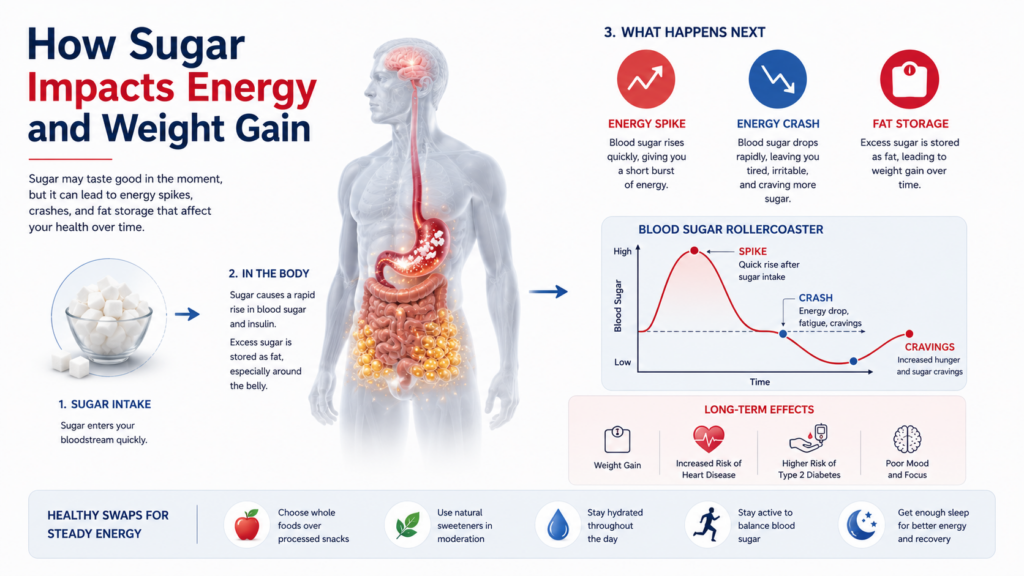
Sugar is one of the most misunderstood parts of modern nutrition. Many people think sugar only affects weight, but its impact goes much deeper. Sugar can influence your energy levels, hunger, cravings, mood, metabolism, fat storage, dental health, and long-term wellness. The problem is not only the sugar you add to tea or coffee. A large amount of sugar comes from packaged foods, soft drinks, flavored yogurt, breakfast cereals, bakery items, sauces, energy drinks, and even “healthy-looking” snacks.
Sugar is not always “bad.” Your body uses glucose as a quick source of energy. Fruits, vegetables, milk, and whole grains naturally contain sugars or carbohydrates that your body can convert into glucose. The real concern is excess added sugar, especially when it comes from sweetened drinks and ultra-processed foods. These foods can provide many calories with little fiber, protein, or micronutrients, making it easier to overeat and gain weight over time.
This article explains how sugar affects energy, why it can contribute to weight gain, how to identify hidden sugar, and practical ways to reduce sugar without feeling deprived.
What Is Sugar?
Sugar is a type of carbohydrate. When you eat carbohydrates, your body breaks many of them down into glucose, which enters your bloodstream and provides energy to your cells. Common forms of sugar include glucose, fructose, sucrose, lactose, and maltose.
You can learn more about the basic science of sugar from Wikipedia’s page on sugar.
Natural Sugar vs. Added Sugar
| Type of Sugar | Where It Comes From | Example Foods | Health Impact |
| Natural sugar | Naturally present in whole foods | Fruits, milk, vegetables | Usually comes with fiber, vitamins, minerals, and water |
| Added sugar | Added during processing or preparation | Soda, candy, cookies, sweetened cereal, flavored drinks | Can increase calorie intake and may contribute to weight gain when consumed in excess |
A banana contains natural sugar, but it also contains fiber, potassium, water, and antioxidants. A sugary drink may contain similar or higher sugar but little nutrition and almost no fiber. This difference matters because fiber slows digestion and helps control hunger.
How Sugar Gives You Quick Energy
When you eat sugar, it is quickly digested and absorbed into your bloodstream. This raises blood glucose levels. In response, your pancreas releases insulin, a hormone that helps move glucose from your blood into your cells.
This process can give you a quick energy boost. That is why people often reach for sweet snacks when they feel tired. However, this energy boost may not last long, especially when sugar is eaten without fiber, protein, or healthy fats.
The Sugar Energy Cycle
| Step | What Happens in the Body | How You May Feel |
| 1. You eat or drink sugar | Blood sugar rises quickly | Quick energy, alertness |
| 2. Insulin is released | Glucose moves into cells | Energy may feel stable for a short time |
| 3. Blood sugar may drop | Especially after high-sugar foods | Tiredness, hunger, irritability |
| 4. Cravings return | Brain seeks more quick energy | Desire for sweets or snacks |
This cycle can make some people feel like they need sugar again and again throughout the day. Not everyone experiences a strong “sugar crash,” but many people notice unstable energy after consuming sugary snacks or drinks.
Why Sugar Can Cause Energy Crashes
High-sugar foods that are low in fiber and protein digest quickly. This can lead to a rapid rise in blood glucose followed by a quick fall. When blood sugar drops, you may feel tired, unfocused, hungry, or moody.
This does not mean sugar is the only cause of fatigue. Poor sleep, dehydration, stress, low iron, low vitamin D, thyroid problems, and other health conditions can also affect energy. But if your day includes frequent sweet drinks, desserts, and refined snacks, sugar may be one reason your energy feels unstable.
For general nutrition guidance, the CDC explains added sugars and why limiting them can support better health.
How Sugar Contributes to Weight Gain
Weight gain happens when calorie intake regularly exceeds calorie use. Sugar can contribute to this because many sugary foods are calorie-dense but not very filling. This makes it easy to consume more calories than your body needs.
1. Sugary Drinks Add Calories Without Fullness
Liquid sugar is one of the biggest concerns. Soft drinks, sweet tea, energy drinks, fruit drinks, and flavored coffee drinks can contain large amounts of added sugar. Because liquid calories do not create the same fullness as solid foods, people may drink extra calories without eating less later.
For example, a sugary drink may contain 150–300 calories. If someone drinks one daily and does not reduce calories elsewhere, that can add up over weeks and months.
Scientific research has linked sugar-sweetened beverages with increased body weight and metabolic risk. A well-known study published in The New England Journal of Medicine found that genetic risk for obesity may be amplified by higher intake of sugar-sweetened beverages:
Qi et al., 2012 – Sugar-Sweetened Beverages and Genetic Risk of Obesity
2. Sugar Can Increase Cravings
Sweet foods activate reward pathways in the brain. This does not mean sugar is the same as addictive drugs, but it can make sweet foods highly appealing and easy to overconsume. The more often someone eats very sweet foods, the more their taste preferences may shift toward stronger sweetness.
This can make naturally sweet foods like fruit feel less satisfying compared with candy, desserts, or sweetened snacks.
3. Sugar Often Comes With Refined Flour and Fat
Many high-sugar foods are not just sugar. Cakes, cookies, pastries, doughnuts, and desserts often combine sugar with refined flour and fats. This combination can make foods highly palatable and calorie-dense.
| Food Type | Why It May Promote Weight Gain |
| Soda and sweet drinks | High calories, low fullness |
| Candy | Easy to overeat, low nutrition |
| Cakes and pastries | Sugar + refined flour + fat |
| Sweetened cereals | Often low in fiber and high in added sugar |
| Flavored yogurt | Can contain added sugar despite healthy image |
| Packaged snacks | Designed to be tasty and easy to overeat |
4. Excess Sugar Can Be Stored as Fat
When you consume more energy than your body needs, the excess can be stored as fat. Glucose can be stored as glycogen in muscles and the liver, but storage space is limited. When energy intake remains high, the body stores excess calories as body fat.
Fructose, a type of sugar found in table sugar and high-fructose corn syrup, is mainly processed in the liver. Excess fructose intake, especially from sugary drinks, has been studied for its role in liver fat accumulation and metabolic problems.
The Harvard T.H. Chan School of Public Health provides a helpful overview of added sugar and its health effects.
Sugar, Insulin, and Fat Storage
Insulin is often misunderstood. Insulin is not “bad.” It is an essential hormone that helps your body use and store energy. After eating carbohydrates, insulin helps move glucose into cells. It also helps store energy for later use.
However, when a diet is consistently high in added sugar, refined carbohydrates, and excess calories, insulin levels may remain elevated more often. Over time, some people may develop insulin resistance, where the body’s cells do not respond to insulin as well. This can make blood sugar control more difficult and may increase the risk of type 2 diabetes.
The relationship between sugar, insulin, and weight is complex. Sugar alone does not automatically cause weight gain, but high added sugar intake can make overeating easier and may worsen metabolic health when combined with low activity, poor sleep, stress, and excess calorie intake.
Hidden Sources of Sugar
Many people reduce desserts but still consume sugar through everyday foods. Food labels may list added sugar under many names.
Common Names for Added Sugar
| Label Name | What It Means |
| Sucrose | Table sugar |
| High-fructose corn syrup | Sweetener used in processed foods and drinks |
| Corn syrup | Liquid sweetener |
| Dextrose | A form of glucose |
| Maltose | Sugar made of two glucose units |
| Cane sugar | Added sugar from sugarcane |
| Brown sugar | Sugar with molasses |
| Honey | Natural sweetener but still sugar |
| Agave syrup | Sweetener high in fructose |
| Fruit juice concentrate | Concentrated sugar from fruit juice |
Even natural sweeteners like honey, maple syrup, and agave still count as added sugar when used to sweeten foods.
How Much Sugar Is Too Much?
The World Health Organization recommends reducing free sugars to less than 10% of total daily energy intake, with further benefits suggested below 5%. Free sugars include added sugars and sugars naturally present in honey, syrups, fruit juices, and fruit juice concentrates. You can read the WHO guideline here:
WHO Guideline: Sugars Intake for Adults and Children
The American Heart Association recommends limiting added sugar to about 6 teaspoons per day for most women and 9 teaspoons per day for most men. One teaspoon of sugar is about 4 grams.
| Group | Suggested Added Sugar Limit | Approx. Grams |
| Most women | 6 teaspoons/day | 24 grams |
| Most men | 9 teaspoons/day | 36 grams |
| Children | Often lower depending on age and needs | Varies |
These are general guidelines, not personalized medical advice. Athletes, people with medical conditions, and people with different calorie needs may require individual guidance.
Sugar and Belly Fat
Many people worry specifically about belly fat. Excess calories from any source can contribute to fat gain, including abdominal fat. However, sugary drinks and high-fructose intake have been studied in relation to visceral fat, which is fat stored around internal organs.
Visceral fat is more strongly linked with metabolic problems than fat stored under the skin. Reducing sugary drinks is one practical step that may support healthier body composition over time.
A scientific review published in The American Journal of Clinical Nutrition found that higher intake of sugar-sweetened beverages is associated with weight gain and obesity risk:
Malik et al., 2006 – Intake of Sugar-Sweetened Beverages and Weight Gain
How Sugar Affects Hunger and Appetite
Sugar-rich foods are often low in fiber and protein, two nutrients that help you feel full. This means you may eat a sweet snack and feel hungry again soon afterward.
Compare these two snacks:
| Snack | Sugar Level | Fiber/Protein | Fullness |
| Candy bar | High | Low | Short-lasting |
| Apple with peanut butter | Moderate natural sugar | Fiber + healthy fat + some protein | Longer-lasting |
| Sweetened cereal | Often high | Often low | May not last long |
| Oats with nuts and berries | Lower added sugar | Fiber + protein + healthy fats | More stable energy |
A better strategy is not to remove all sweetness. Instead, combine carbohydrates with fiber, protein, and healthy fats. This helps slow digestion and supports steady energy.
Signs You May Be Eating Too Much Added Sugar
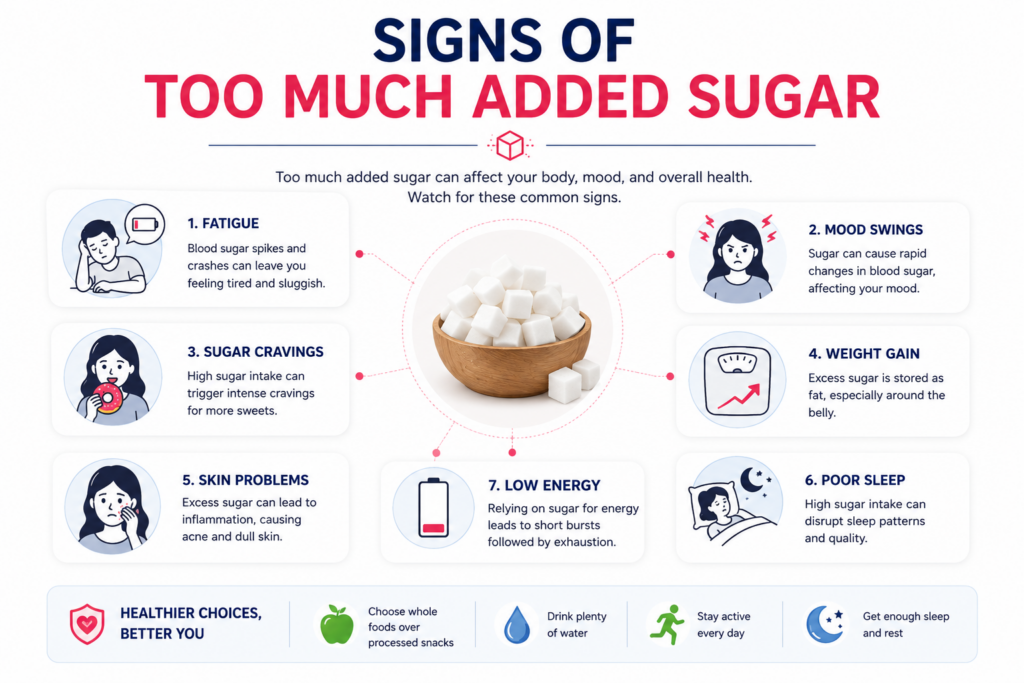
You may want to review your sugar intake if you often notice:
| Sign | Possible Connection |
| Energy crashes | Blood sugar rises and falls quickly |
| Frequent cravings | Sweet foods may increase desire for more sweetness |
| Weight gain | Extra calories from sugar can add up |
| Constant hunger | Low-fiber sugary foods may not satisfy |
| Poor dental health | Sugar feeds bacteria that contribute to tooth decay |
| High triglycerides | Excess sugar may affect blood fats |
| Fatty liver concerns | Excess fructose intake may contribute in some people |
These signs can have many causes, so it is best to consult a healthcare professional if symptoms are persistent or severe.
Practical Ways to Reduce Sugar Without Feeling Deprived
Reducing sugar does not mean eating bland food. Small changes can make a big difference.
1. Replace Sugary Drinks First
This is one of the most effective steps. Try water, sparkling water, unsweetened tea, lemon water, or lightly flavored water without added sugar.
2. Choose Whole Fruits Instead of Fruit Juice
Whole fruit contains fiber, which slows sugar absorption and improves fullness. Fruit juice removes much of the fiber and makes it easier to consume too much sugar quickly.
3. Read Nutrition Labels
Look for “Added Sugars” on packaged foods. Compare brands and choose lower-sugar options when possible.
4. Build Balanced Meals
A balanced plate should include protein, fiber-rich carbohydrates, healthy fats, and vegetables.
| Meal Component | Examples |
| Protein | Eggs, lentils, Greek yogurt, tofu, chicken, fish, beans |
| Fiber-rich carbs | Oats, brown rice, quinoa, whole wheat, sweet potato |
| Healthy fats | Nuts, seeds, avocado, olive oil |
| Vegetables | Leafy greens, carrots, peppers, broccoli |
| Natural sweetness | Berries, apples, bananas, dates in small amounts |
5. Reduce Gradually
If you add two teaspoons of sugar to tea, reduce it to one and a half, then one. Your taste buds can adapt over time.
6. Keep Sweet Foods Occasional, Not Daily Staples
Desserts can still fit into a healthy diet, but they should not replace nutrient-rich foods. Enjoy them mindfully and in reasonable portions.
Best Low-Sugar Swaps
| Instead of This | Try This |
| Soda | Sparkling water with lemon |
| Sweetened cereal | Oats with berries and nuts |
| Candy | Fruit with yogurt |
| Flavored yogurt | Plain yogurt with cinnamon and fruit |
| Sweet coffee drinks | Coffee with milk and less sugar |
| Packaged cookies | Homemade energy bites with oats and nuts |
| Fruit juice | Whole fruit |
Scientific References
- Malik VS, Schulze MB, Hu FB. Intake of sugar-sweetened beverages and weight gain: a systematic review. American Journal of Clinical Nutrition. 2006.
https://pubmed.ncbi.nlm.nih.gov/16895873/ - Qi Q, Chu AY, Kang JH, et al. Sugar-Sweetened Beverages and Genetic Risk of Obesity. New England Journal of Medicine. 2012.
https://www.nejm.org/doi/full/10.1056/NEJMoa1203039 - Te Morenga L, Mallard S, Mann J. Dietary sugars and body weight: systematic review and meta-analyses. BMJ. 2013.
https://www.bmj.com/content/346/bmj.e7492 - World Health Organization. Guideline: Sugars Intake for Adults and Children.
https://www.who.int/publications/i/item/9789241549028 - Harvard T.H. Chan School of Public Health. Added Sugar in the Diet.
https://www.hsph.harvard.edu/nutritionsource/carbohydrates/added-sugar-in-the-diet/
Trusted Health and Wellness Links
- Wikipedia: Sugar
- CDC: Be Sugar Smart
- Harvard Nutrition Source: Added Sugar
- World Health Organization: Sugar Intake Guideline
- MedlinePlus: Dietary Sugars
Conclusion
Sugar affects the body in more ways than many people realize. It can provide quick energy, but too much added sugar may lead to energy crashes, cravings, overeating, and gradual weight gain. The biggest concern is not natural sugar from whole foods like fruits and milk, but added sugar from sweetened drinks, desserts, packaged snacks, and processed foods.
For better energy and weight control, focus on reducing sugary drinks, reading food labels, choosing whole foods, and building balanced meals with protein, fiber, and healthy fats. You do not need to remove sugar completely. The goal is to use it wisely, reduce excess intake, and create a diet that supports steady energy, better appetite control, and long-term health.